Destinations
Amalfi Coast vs. Greek Islands: Mediterranean Honeymoon Showdown
Italy's cliffside glamour or Greece's caldera sunsets? A clear-eyed comparison of two of the Mediterranean's most romantic honeymoon coastlines — cost, scenery, logistics and vibe.
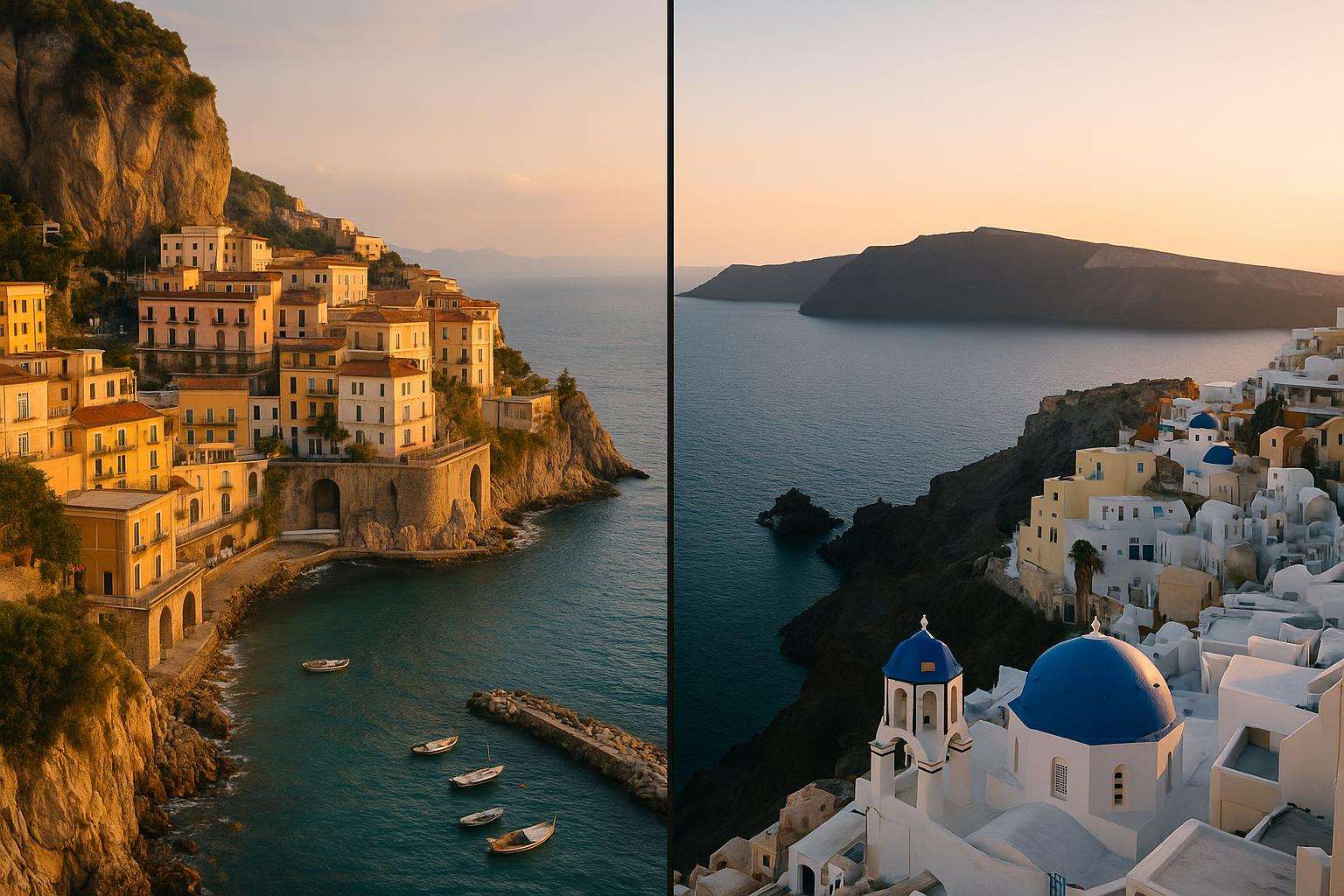
Ask ten couples to name the most romantic corner of the Mediterranean and the answers cluster in two places: Italy's Amalfi Coast and Greece's Cycladic islands. Both are genuine icons. Both photograph like a dream. But they reward very different honeymoons, and choosing between Positano and Santorini — or between Capri and Mykonos — is really a question about what kind of couple you are. Here is the honest comparison.
What is the Amalfi Coast honeymoon really like?
The Amalfi Coast is a 50-kilometer UNESCO World Heritage coastline of cliffs, pastel towns and tiered lemon groves above the Tyrrhenian Sea.[UNESCO] Its register is grown-up glamour: long lunches, ceramic shopping in Positano, a ferry to Capri, and the kind of Italian food that reorganizes your expectations. The most iconic property on the stretch, Il San Pietro di Positano, a Relais & Chateaux member carved into the cliff face with a private beach and a Michelin-starred restaurant, starts around 616 euros per night. Up in Ravello, the 11th-century Belmond Hotel Caruso — with its suspended infinity pool and butler service — begins around $820 per night on comparison platforms.[KAYAK]
The experience is anchored to one coastline. You do not island-hop; you settle into Positano, take a day trip by boat to Capri's Faraglioni rock arches and Blue Grotto, and drive (or better, are driven) the vertiginous SS163 to Amalfi town and Ravello. It is elegant, culturally rich and food-forward — and it is not a party destination. Couples who want quiet sophistication over nightlife find their match here.
What do the Greek islands offer that Italy doesn't?
Greece's advantage is range. Santorini owns the single most recognizable romantic image in the Mediterranean — whitewashed cave-suites stacked on a volcanic caldera rim, watching the sun sink into the Aegean from Oia. The Grace Hotel in Imerovigli was named the No. 1 Resort in Europe and Greece by Travel + Leisure's 2025 World's Best Awards, with peak rates averaging around $1,507 per night and shoulder-season options far lower.[KAYAK] Cave-suites at benchmark Oia properties like Canaves Oia routinely run $800 to $1,200 per night in peak season.
Then there is Mykonos — louder, sexier and more socially oriented, with Cycladic white-cube lanes, beach clubs at Psarou and Scorpios, and a nightlife scene that Santorini deliberately lacks. A classic Greek honeymoon splits roughly four nights on Santorini for caldera romance and three on Mykonos for energy, linked by a 2-to-2.5-hour high-speed ferry. That built-in variety — quiet-then-lively, or the reverse — is something a single Italian coastline cannot replicate.
How do cost, logistics and timing compare?
At the luxury tier the two are broadly comparable, though the Amalfi Coast edges higher at the very top. Greece tends to win on shoulder-season value: Santorini rates fall 30–40% in September and October, and Greece's Climate Resilience Fee — charged per person per night — drops about 70% on November 1.[Greek Trip Planner] Total luxury spend for a 7-to-10-day Greece honeymoon runs roughly $7,000 to $15,000 per couple.
Logistics diverge sharply. The Amalfi Coast keeps you on one traffic-choked but scenic highway, with ferries and boat tours doing the heavy lifting; the Greek islands demand ferries or short flights to move between islands. Both are best approached with pre-booked transfers and a relaxed pace rather than a rental car.
| Factor | Amalfi Coast (Italy) | Greek Islands |
|---|---|---|
| Signature image | Pastel cliffs of Positano; Capri sea arches | Santorini caldera sunset over Oia |
| Vibe | Refined, food- and culture-forward, quiet | Varied: caldera romance + Mykonos nightlife |
| Flagship stay | Il San Pietro; Belmond Caruso, Ravello | Grace Hotel; Canaves Oia, Santorini |
| Peak nightly (luxury) | ~616 euros–$2,000+ | ~$800–$1,500+ |
| Getting around | One coastal highway + ferries/boats | Inter-island ferries + short flights |
| Best months | May–June, September | May–June, September |
The bottom line: Choose the Amalfi Coast for cultured elegance, extraordinary Italian food and a single dreamy coastline. Choose the Greek islands for the definitive caldera-sunset photo, island-hopping variety and the freedom to pair quiet romance with lively nights. Greece typically offers a touch better value; the Amalfi Coast a touch more polish.
The honest tradeoffs
The Amalfi Coast's weaknesses are real: summer traffic on the SS163 is punishing, beaches are pebble rather than sand (bring reef shoes), and the marquee hotels book out 12 months ahead for July and August. Ferry service and many restaurants also close from late October through winter, so a beach honeymoon must be timed for the warm shoulder months. Santorini's weakness is crowding — the Oia sunset draws throngs, and peak-summer rates and heat are steep — while Mykonos can feel more scene than romance for couples seeking seclusion. Non-EU travelers now need an ETIAS waiver for either destination. There is also a subtler difference worth naming: the Amalfi Coast rewards couples who love to sit and savor — long meals, a good book on a lemon-shaded terrace, a slow boat around Capri — while the Greek islands reward couples who like to move, explore and shift scenes. Neither is objectively better; they simply pace a honeymoon differently. Pick the coast that matches your temperament, go in May or September, and either choice becomes unforgettable.
Frequently asked
Is the Amalfi Coast or the Greek islands better for a honeymoon?
Both are world-class, but they suit different couples. The Amalfi Coast is the more refined, food-and-culture-forward choice: pastel cliffside towns, Michelin dining, day trips to Capri and Pompeii, and a slower, more grown-up glamour. The Greek islands are more varied in register — Santorini delivers the iconic caldera-sunset romance, while Mykonos layers in beach clubs and nightlife. If you want cultured elegance, superb Italian food and dramatic coastal drives, choose the Amalfi Coast. If you want the definitive caldera-sunset photo, island-hopping variety and the option of both quiet and party, choose Greece. Many couples find Greece slightly better value and the Amalfi Coast slightly more polished.
Which is more expensive, the Amalfi Coast or Santorini?
They are broadly comparable at the luxury tier, though the Amalfi Coast edges higher at the very top. Amalfi flagships like Il San Pietro di Positano start around 616 euros per night and the Belmond Hotel Caruso in Ravello from roughly $820, while cliffside Santorini cave-suites in Oia routinely run $800 to $1,200 per night in peak season, with the Travel + Leisure-topped Grace Hotel averaging around $1,507 in high summer. Total luxury spend for a 7-to-10-day Greece honeymoon runs roughly $7,000 to $15,000 per couple. Greece often wins on shoulder-season value: Santorini rates drop 30–40% in September and October, and Greece's Climate Resilience Fee falls about 70% on November 1.
When is the best time for an Amalfi Coast or Greek islands honeymoon?
For both, the shoulder seasons of May–June and September–October are the sweet spot: warm seas, thinner crowds and materially lower rates than July–August. September is arguably the single best month for either destination — Mediterranean sea temperatures peak (around 24C in the Aegean, 23C in the Tyrrhenian) just as European school holidays end and crowds thin. Avoid peak July and August if you can, when both coasts run hot, expensive and crowded, and Greek island accommodation inflates to two or three times shoulder-season rates. Note that Amalfi Coast ferries and many hotels close from late October through winter, so time a spring or autumn beach honeymoon for May or September specifically.
Is it easier to get around the Amalfi Coast or the Greek islands?
Neither is effortless, but the challenges differ. The Amalfi Coast is a single narrow, winding coastal highway (SS163) where summer traffic is severe; most couples rely on private transfers, ferries and boat tours rather than driving. Naples airport is a roughly 90-minute transfer to Positano. The Greek islands require ferries or short flights between islands — a Santorini-to-Mykonos high-speed ferry takes 2 to 2.5 hours and should be booked weeks ahead in summer. Neither is ideal for couples who want to simply hop in a rental car, but the Amalfi Coast keeps you on one coastline while Greece rewards those willing to island-hop. Both are best approached with pre-booked transfers and a relaxed pace.
Should we combine Positano, Capri, Santorini and Mykonos on one trip?
Combining Italy and Greece in a single honeymoon is ambitious but doable with 12 or more nights and a flight between them (Naples to Athens, then a domestic hop or ferry to the islands). A cleaner approach is to pick one country and go deep: on the Amalfi Coast, base in Positano with a Capri day trip and a night in Ravello; in Greece, split roughly four nights in Santorini and three in Mykonos. Trying to do all four destinations in under 10 days means too many transfer days and too little actual honeymoon. If your heart is set on both countries, extend the trip length rather than compressing the itinerary.