Destinations
Patagonia & South America Adventure Honeymoon: Argentina, Chile & Peru
The definitive multi-country framework for adventure couples — Torres del Paine granite towers, El Chaltén trekking, and Machu Picchu — with real Explora and Awasi pricing, seasons, and lead times.
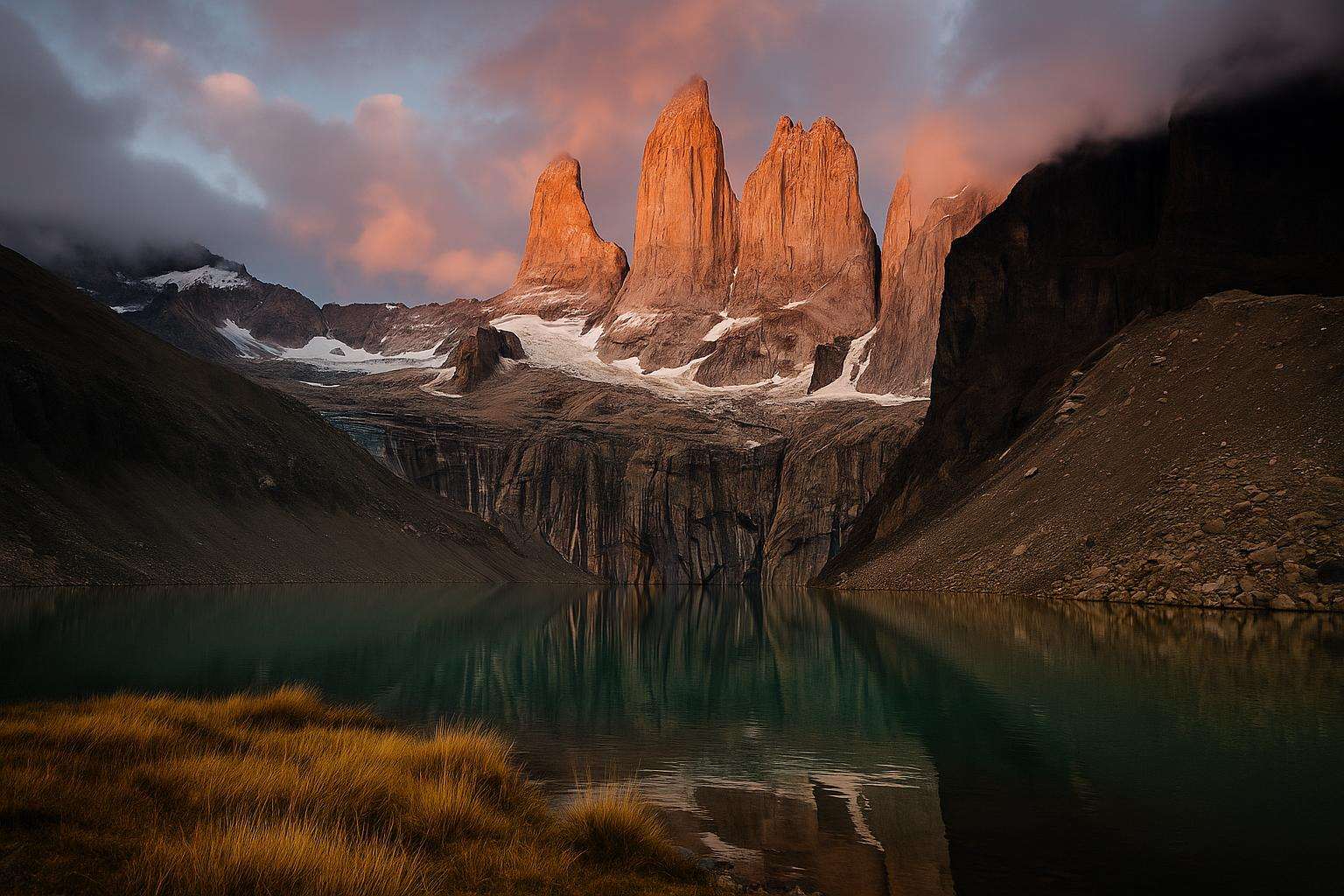
There is a particular quality of light in Patagonia the first morning the wind drops. I have stood on the shore of Lago Pehoé before dawn, coffee going cold in my hand, watching the granite of the Torres del Paine massif go from charcoal to rose to hard white as the sun cleared the steppe. No photograph prepares you for the scale. This is the honeymoon destination that trades the overwater bungalow's soft luxury for something older and more elemental — and when you fold in Peru's Sacred Valley and Machu Picchu, you have South America's definitive adventure itinerary, a trip that spans calving glaciers and Inca terraces in a single arc.
This guide is built for the couple who wants monumental wilderness over a swim-up bar, and who is willing to trade a little comfort and a lot of transfer time for landscapes that genuinely have no equal. Below is how the itinerary actually structures, what the benchmark lodges cost, when to go, and the honest tradeoffs nobody's brochure mentions.
Why Patagonia rewards adventure couples like nowhere else
Patagonia is the shared southern extreme of Chile and Argentina — soaring granite towers, electric-blue lakes, calving glaciers, and wind-scoured steppe that remains largely as it has been for millennia. The centerpiece is Torres del Paine National Park in Chile, whose iconic granite formations — Paine Grande, the Cuernos del Paine, and the three Torres themselves — are the reason most couples come. The classic guided explorations here are the French Valley trek, the Mirador Cuernos viewpoint, the Salto Grande waterfall, and a boat crossing to Grey Glacier, where you sail past icebergs calved from the Southern Patagonian Ice Field.
Across the border in Argentina, El Chaltén is the national trekking capital, anchored by the Fitz Roy massif. The Laguna de los Tres trail to the base of Mount Fitz Roy is a 22-kilometer round-trip day hike widely considered one of the finest in South America. Nearby, El Calafate is the gateway to the Perito Moreno Glacier — one of the world's few advancing glaciers, reachable by a short boat and boardwalk, where you can stand close enough to hear the ice crack and watch blocks the size of buildings collapse into the milky water below.
Where to stay: Explora, Awasi, and EcoCamp compared
Explora Hotels is the definitive luxury lodge network for Patagonia and Peru, repeatedly recognized as a leading expedition company and the standard-bearer for all-inclusive adventure lodging in remote South America. The model is what makes it work for a honeymoon: all meals, bar, guided explorations, national park entrance fees and inter-lodge private-flight transfers are included, so you spend your energy on the trails, not on logistics. The network spans Torres del Paine, El Chaltén and El Calafate, the Atacama Desert, Easter Island, and Peru's Sacred Valley. Two new lodges — Explora El Calafate and an Explora Torres del Paine Conservation Reserve property — are slated to open in December 2026, extending the cross-border reach. You can review the current network and offers on the official Explora Patagonia site.
Awasi Patagonia is the private alternative. A Relais & Châteaux property with just fourteen villas, it assigns each couple a private guide and private 4WD vehicle — you explore entirely on your own schedule, which is a real luxury when a honeymoon is meant to feel unhurried. EcoCamp Patagonia occupies a more accessible glamping tier, with geodesic dome accommodations in three categories and guided treks included; its five-day, four-night all-inclusive package runs roughly $1,645–$4,495 per person depending on dome category and season, making it the entry point for couples who want the wilderness without the top-tier lodge rate.
Patagonia lodge pricing at a glance
| Lodge | Model | Starting price (2026, per person) | Best for |
|---|---|---|---|
| Explora Patagonia (Torres del Paine) | All-inclusive, guided group explorations | ~$9,196 (8-night TdP + El Chaltén program) | Range, scale, cross-border network |
| Explora full Patagonia circuit | All-inclusive, 12 nights across three areas | ~$15,386 | Comprehensive, once-in-a-lifetime |
| Awasi Patagonia | Private guide + private 4WD, all-inclusive | ~$3,300 (shoulder, 4-night minimum) | Maximum privacy and autonomy |
| EcoCamp Patagonia | Geodesic dome glamping, guided treks | ~$1,645–$4,495 (5-day/4-night package) | Value and a lighter footprint |
The honeymoon economics deserve a close read. Per Explora, an eight-night Torres del Paine plus El Chaltén program starts from about $9,196 per person (double occupancy, valid October–April), and the twelve-night full circuit from about $15,386 per person. Crucially, Explora's honeymoon benefit gives one person a 50 percent discount on any all-inclusive stay, valid up to six months after the wedding — for Patagonia properties, the benefit applies April–October. Combining Explora destinations across regions also earns up to 25 percent off each additional property, which is exactly what makes the Patagonia-plus-Peru pairing more affordable than it first looks.
Adding Peru: the Sacred Valley and Machu Picchu
Explora Valle Sagrado sits near Urquillo village at roughly 9,514 feet, a 44-room, 6-suite all-inclusive lodge on a 32-hectare historic estate that has earned recurring recognition in Condé Nast Traveler's Readers' Choice Awards. It is a base for more than 40 daily guided explorations across the Sacred Valley: the Ollantaytambo ruins, the Pisaq market, the Moray agricultural terraces, the Maras Salt Mines, and the Machu Picchu day excursion via an Explora-coordinated train from Ollantaytambo (an additional surcharge of around $400 per person). The dining program was developed by chef Virgilio Martínez, whose Lima restaurant Central topped the World's 50 Best Restaurants list in 2023 — a rare case where a remote lodge's kitchen is a destination in itself. Rates run from about $480 per night for a standard room on a bed-and-breakfast basis up to $1,170–$2,240 per night for a suite on the Full Experience all-inclusive plan. Details are on the Explora Valle Sagrado page.
Two practical warnings. First, altitude is real: the Sacred Valley is high, and Cusco is higher. Sleep in the valley first, hydrate hard, go easy the first day, and give yourself a genuine acclimatization day before strenuous trekking. Never push through altitude symptoms; discuss acetazolamide with a travel-medicine physician before departure if you are prone to them. Second, Machu Picchu operates a timed-entry quota system. Explora recommends coordinating the excursion at least 50 days in advance during the May–October high season — do not leave the permit to chance.
How to structure the full 14-day itinerary
Here is the sequence I recommend, built to minimize backtracking and to front-load Patagonia while your legs are fresh:
- Days 1–5 — Torres del Paine, Chile. Explora Patagonia or Awasi. French Valley, Grey Glacier boat, the base-of-the-towers hike.
- Days 6–7 — El Calafate, Argentina. Perito Moreno Glacier by boat and boardwalk; optional ice-trek with crampons.
- Day 8 — Buenos Aires. One night to reset — a steak dinner, a tango show, a slower morning.
- Days 9–14 — Sacred Valley, Peru. Fly Buenos Aires–Lima–Cusco, transfer to Explora Valle Sagrado. Acclimatize, explore Ollantaytambo and Moray, and take the Machu Picchu day excursion.
The honest tradeoffs: this is a transfer-heavy trip, and the Patagonia-to-Peru leg will eat a full day. Patagonia's wind is genuinely fierce and can cancel boat crossings or reroute hikes — build in buffer days and treat any single sightseeing target as a bonus, not a guarantee. And the peak seasons of the two regions do not perfectly align, so the October and March–April shoulders are usually the smartest compromise. Book the marquee lodges six to twelve months out; the small camps of the region sell out first.
What you get in return is a honeymoon that most couples will describe, years later, as the trip that recalibrated their sense of scale — glaciers that crack like gunfire, towers that turn to fire at dawn, and Andean terraces built by hands five centuries gone. It is not the easy honeymoon. It may well be the one you never stop talking about.
Frequently asked
How many days do you need for a Patagonia and Peru honeymoon?
Plan on at least 12 to 14 nights on the ground to do both regions justice, and that is before international flights. A workable structure is five nights in Torres del Paine (Chile), two nights in El Calafate (Argentina) for the Perito Moreno Glacier, a night or two in Buenos Aires, then a flight to Cusco and five nights in the Sacred Valley including the Machu Picchu day excursion. Trying to compress Patagonia and Peru into under ten nights leaves you exhausted from long transfers and short on the slow mornings that make a honeymoon feel like one. If you only have a week, choose one region — Patagonia for wilderness, Peru for Andean heritage — rather than rushing both.
When is the best time to visit Patagonia for a honeymoon?
Patagonia's primary season is October through April, the austral spring and summer. Torres del Paine sees its heaviest visitor pressure from December through February, so October–November and March–April offer better lodge availability and more manageable winds. Peru's dry season, May through October, delivers the clear skies you want for Machu Picchu and Sacred Valley trekking. That creates a real tension for combined trips: the shoulder overlap in October and March–April is often the smartest compromise, giving you decent Patagonia weather without peak crowds and a workable Peru window. Whatever dates you choose, book the luxury lodges six to twelve months ahead for peak-season stays, per Explora and Awasi availability patterns.
How much does an Explora Patagonia honeymoon cost?
Explora's all-inclusive model bundles all meals, bar, guided explorations, national park entrance fees and inter-lodge private transfers, which removes most logistics friction. According to Explora, an eight-night Torres del Paine plus El Chaltén program starts from roughly $9,196 per person, double occupancy, valid October–April, and a twelve-night full Patagonia circuit starts from about $15,386 per person. Explora's honeymoon benefit provides a 50 percent discount for one person on any all-inclusive stay, valid up to six months post-wedding; for Patagonia properties that benefit applies April–October. Combining Explora destinations across regions earns up to 25 percent off each additional property, which materially changes the math on a Patagonia-plus-Peru itinerary.
Do you need to worry about altitude sickness in the Sacred Valley?
Yes, and it is worth planning for rather than dismissing. Explora Valle Sagrado sits near Urquillo village at roughly 9,514 feet, and Cusco is higher still at about 11,150 feet. The functional approach is to arrive rested, hydrate aggressively, avoid alcohol and heavy meals the first day, and sleep in the Sacred Valley — which is lower than Cusco — before ascending to higher trekking. Many travelers use the local remedy of coca tea, and some physicians prescribe acetazolamide to speed acclimatization; discuss it with a travel-medicine doctor before you go, as it is not right for everyone. Give yourself a genuine acclimatization day before any strenuous hiking, and never treat altitude symptoms — headache, nausea, breathlessness — as something to push through.
Is Awasi Patagonia better than Explora for a private honeymoon?
It depends on how you want to explore. Awasi Patagonia is the region's most private alternative, with just fourteen villas, each assigned its own private guide and private 4WD vehicle — a fully independent model uncommon anywhere in Patagonia. That means you set your own pace and never share a game drive or trailhead schedule, which many honeymooners prize. Per Awasi's published rates, the all-inclusive program starts from about $3,300 per person for shoulder season with a four-night minimum, including lodging, all meals, open bar, Chilean wines, one complimentary massage and private transfers from Puerto Natales. Explora, by contrast, runs guided group explorations from a larger lodge and offers a broader multi-property network. Choose Awasi for maximum privacy and autonomy; choose Explora for scale, range and the cross-border network.
Can you see both Perito Moreno Glacier and Machu Picchu on one trip?
Yes — and it is one of the most rewarding pairings in South America. El Calafate, on the Argentine side of Patagonia, is the gateway to the Perito Moreno Glacier, one of the world's few advancing glaciers, reachable by a short boat trip and boardwalk. From El Calafate you fly to Buenos Aires, connect to Lima, then on to Cusco for the Sacred Valley and Machu Picchu. The transitions are the main cost in time — budget a full travel day for the Patagonia-to-Peru leg — but the payoff is a honeymoon that spans calving glaciers and Inca terraces in a single trip. Explora coordinates the Machu Picchu day excursion by train from Ollantaytambo for an additional surcharge, and recommends arranging timed-entry permits well ahead in high season.