Experiences
Drone Photography on a Honeymoon: Legality & Permits by Country
Greece, Bali, the Maldives and Kenya each regulate honeymoon drone flights differently — and in several cases nearly prohibitively. Here is the real permit chain, no-fly reality and penalty exposure for each, plus legal alternatives that get you the aerial shot.
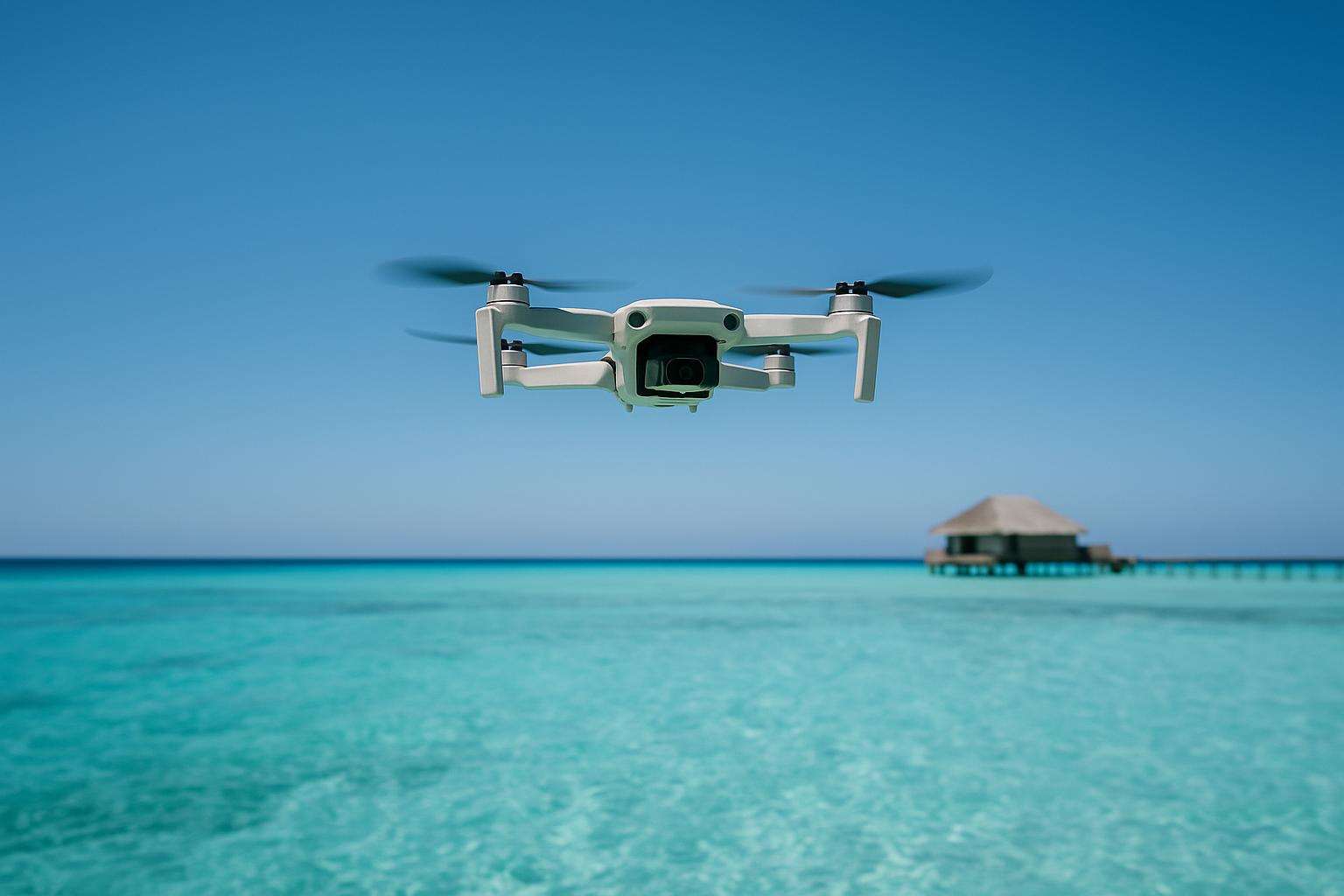
Drone footage has become aspirational for honeymooners — the overwater-villa flyover, the caldera sweep, the migration herds from above — but the regulatory landscape across the top luxury destinations is complex and, in several cases, nearly prohibitive without expert local help and advance preparation. A featherweight DJI Mini 4 Pro does not save you: the sub-250g exemptions that ease flying at home mostly do not apply here. Below is the real permit chain, no-fly reality and penalty exposure for Greece, Bali, the Maldives and Kenya as of 2026 — and the legal ways to still get the aerial shot.
The honest summary: in all four destinations the iconic spots are either no-fly zones or require weeks-to-months of permitting, and weight-based exemptions generally do not apply. For most honeymooners the smart move is to hire a licensed local operator or use a legal alternative — balloon, fixed-wing, rooftop — rather than fly yourself.
Greece (Santorini): where can I actually fly?
Greece operates under the EU/EASA framework, administered nationally by the Hellenic Civil Aviation Authority (HCAA). Any camera drone — regardless of weight — requires registration. Non-EU visitors must email the HCAA (d2d@hcaa.gr) at least two weeks before travel, and all pilots must pre-file flights through the DAGR notification system a minimum of five working days ahead; Greek holidays and weekends do not count toward that window. Santorini is especially constrained: the entire caldera rim — Fira, Oia and Imerovigli — is a designated no-fly zone, the island has twelve total no-fly zones, and the airport adds controlled airspace over much of the rest. Police actively confiscate drones in peak season (June–August), and unauthorized overflight of archaeological no-fly zones carries fines up to €250,000. The practical upshot: drone photography in Oia or Fira is not legally available without a ministerial permit rarely granted to tourists. Photographers on private rooftops and terraces, technically off the no-fly rim, are the only realistic route to aerial-adjacent imagery.
Bali: what changed in 2025?
Since January 2025, all drones in Bali must be pre-registered via the SIPUDI portal (SIPP-TA) regardless of weight — the sub-250g exemption does not apply. Registration requires the drone's make, model, serial number and weight; a passport and local Indonesian contact address; proof of liability insurance; and ownership documentation, with 3–5 business days' processing and no expedited option, so allow at least ten days. The airport exclusion zone around Ngurah Rai covers a 15-kilometer radius encompassing Kuta, Seminyak, Sanur, Nusa Dua and Jimbaran, and sacred temples carry a 5-kilometer exclusion under Bali Regional Regulation. For any commercial photography, a foreign operator must hold an Indonesian Remote Pilot Certificate or partner with a licensed local company — neither obtainable on a tourist visa. Penalties are steep: fines up to roughly USD 308,000 and up to five years' imprisonment for restricted-airspace violations, with temple RF detection enabling complaints up to 90 days after a flight. Safer airspace exists in northern and eastern Bali — Sidemen, Lovina, Singaraja and Pemuteran.
The Maldives: why is it the hardest?
The Maldives applies the most uniform and burdensome requirements, with no weight-based exemption — a 249g DJI Mini follows the identical process as a full commercial drone. The approval chain is four sequential steps: (1) written permission from resort or island management; (2) National Centre for the Arts clearance for commercial filming, with at least ten working days' notice; (3) Maldives National Defence Force military security clearance; and (4) a final MCAA aviation permit via form CAA/AD/05. There is no online portal — everything is submitted by email or in person in Malé — and total processing runs a minimum of three to four weeks. Altitude limits are 50 meters in urban areas and about 150 meters over open water; night flying is prohibited, and seaplane water aerodromes near resorts are off-limits. Resort stances vary widely: many Ari Atoll resorts ban drones for privacy, while Soneva Fushi and Four Seasons Landaa Giraavaru have accommodated flights with prior arrangement. Customs does not confiscate on arrival — the restriction is on flying, not importing.
Kenya: can I fly on safari?
Kenya's Civil Aviation Authority (KCAA) treats all drones as aircraft, requiring a Remote Pilot License, operator certificate and a temporary permit for every tourist who wishes to fly, all processed through the eCitizen portal over several weeks — start two to six months ahead. Critically, the Kenya Wildlife Service independently prohibits all drone operations inside national parks and reserves, including the Maasai Mara, Amboseli and Tsavo, and a valid KCAA permit does not override KWS rules. Professional filming in the Mara requires three separate permits — KCAA registration, KWS special permission and a Kenya Film Commission license — with non-resident fees around USD 300 per drone per day per park. Many private conservancies adjacent to the parks enforce their own no-drone policies, so confirm with your lodge before applying.
How do I get the shot legally?
| Destination | Iconic spots | Lead time | Legal alternative |
|---|---|---|---|
| Greece (Santorini) | Caldera rim = no-fly | 2 weeks + 5 working days | Rooftop / terrace photographer |
| Bali | Airport + temple zones banned | 10+ days registration | Licensed local operator; N/E Bali |
| Maldives | 4-step permit; many resorts ban | 3–4 weeks | Resort in-house / licensed operator |
| Kenya | Parks banned by KWS | 2–6 months | Hot-air balloon; fixed-wing flight |
The reliable path in every case is either a licensed local operator who already holds the credentials, or a legal aerial substitute. In Kenya, a hot-air balloon over the Maasai Mara is entirely legal and wildlife-friendly, and scenic fixed-wing flights over the Great Rift Valley deliver comparable landscape imagery. In the Maldives, resort in-house teams or a pre-arranged licensed operator sidestep the multi-week permit chain. Before any trip, consult the destination's civil aviation authority directly, cross-reference the EASA drone map for EU countries, check the specific park or resort policy in writing, and verify current no-fly overlays through DJI's Fly Safe system — never rely on travel-forum anecdotes, which are frequently outdated.
The bottom line
A drone can produce the single most memorable image of a honeymoon, but at these destinations flying it yourself is rarely worth the paperwork or the penalty risk. Assume the iconic view is a no-fly zone, budget weeks to months for permits if you insist on your own flight, and default to a licensed local operator or a balloon or fixed-wing flight for the aerial perspective. Verify every rule in writing with the aviation authority and the specific resort or park — the fines in Bali and Greece alone run into the hundreds of thousands, and no photo is worth that.
Frequently asked
Can I fly a small drone like the DJI Mini 4 Pro without permits because it is under 250g?
Usually not at these destinations. The sub-250g exemption familiar to EU and Australian pilots does not apply in Bali, where every drone must be pre-registered via the SIPUDI portal regardless of weight since January 2025, nor in the Maldives, where a 249g DJI Mini undergoes the identical approval process as a full-size commercial drone. In Greece, any drone with a camera — regardless of weight — requires registration. Kenya treats all drones as aircraft requiring a Remote Pilot License and a temporary permit. So a DJI Mini 4 Pro simplifies transport and airspace impact but does not free you from the paperwork at any of the four.
Is it legal to fly a drone in Santorini?
Effectively no in the iconic spots. Greece operates under the EU/EASA framework via the Hellenic Civil Aviation Authority, and the entire Santorini caldera rim — Fira, Oia and Imerovigli — is a designated no-fly zone. The island has twelve total no-fly zones, its airport creates additional controlled airspace, and police actively confiscate drones during peak season (June–August). Non-EU visitors must email the HCAA at least two weeks before travel and pre-file every flight through the DAGR system a minimum of five working days ahead. Drone photography in Oia or Fira is not legally available without a rarely granted ministerial permit; unauthorized archaeological-site overflight carries fines up to €250,000.
What is the drone permit process in the Maldives?
The Maldives applies the most burdensome requirements of the four, with no weight-based exemption. The approval chain has four sequential steps: written permission from the resort or island management; National Centre for the Arts clearance for commercial filming with at least ten working days' notice; Maldives National Defence Force military security clearance; and a final MCAA aviation permit via form CAA/AD/05. There is no online portal — everything is submitted by email or in person at the MCAA office in Malé, and total processing takes a minimum of three to four weeks. Many Ari Atoll resorts ban drones outright for privacy, though Soneva Fushi and Four Seasons Landaa Giraavaru have accommodated flights with prior arrangement.
Can I fly a drone on a Kenya safari in the Maasai Mara?
No — not inside the parks. The Kenya Wildlife Service independently prohibits all drone operations inside national parks and national reserves, including the Maasai Mara, Amboseli and Tsavo, and a valid KCAA permit does not override that. Kenya's Civil Aviation Authority treats all drones as aircraft, requiring a Remote Pilot License, operator certificate and a temporary permit processed through the eCitizen portal, which takes several weeks — start two to six months ahead. Professional filming in the Mara requires three separate permits (KCAA, KWS special permission and a Kenya Film Commission license), with non-resident fees around USD 300 per drone per day per park. Many private conservancies enforce their own no-drone policies too.
How do I get aerial-style shots legally if drones are banned?
Several legal alternatives deliver comparable perspectives. In Kenya, hot-air balloon experiences over the Maasai Mara are entirely legal and wildlife-friendly, as are scenic fixed-wing flights over the Great Rift Valley — both give you the sweeping landscape imagery a drone would. In Santorini, photographers positioned on private rooftops and clifftop terraces (technically away from the no-fly caldera rim) capture aerial-adjacent images. In Bali and the Maldives, the reliable route is hiring a licensed local drone operator or videographer who already holds the required credentials, rather than flying yourself — in Bali, commercial work legally requires an Indonesian Remote Pilot Certificate or a licensed local company partner.
What are the penalties if I fly illegally?
They are severe enough to end a honeymoon. In Greece, unauthorized overflight of archaeological no-fly zones carries fines up to €250,000, and police confiscate drones in peak season. Bali imposes fines up to roughly USD 308,000 and up to five years' imprisonment for restricted-airspace violations, with temple-zone breaches risking confiscation and deportation — and temple RF detection means complaints can be filed up to 90 days after a flight. The Maldives penalizes with on-the-spot confiscation, resort fines up to $5,000 and government fines. Kenya enforces through park authorities and the KCAA. The practical takeaway: never rely on forum anecdotes; verify with the country's civil aviation authority and the specific park or resort in writing.