The Milestones
How to Travel With an Engagement Ring: TSA, Insurance & Hiding It
The complete pre-flight playbook for getting a ring to your proposal destination safely and secretly — TSA screening rules, when insurance actually matters, customs on re-entry, and the tricks that keep the surprise intact.
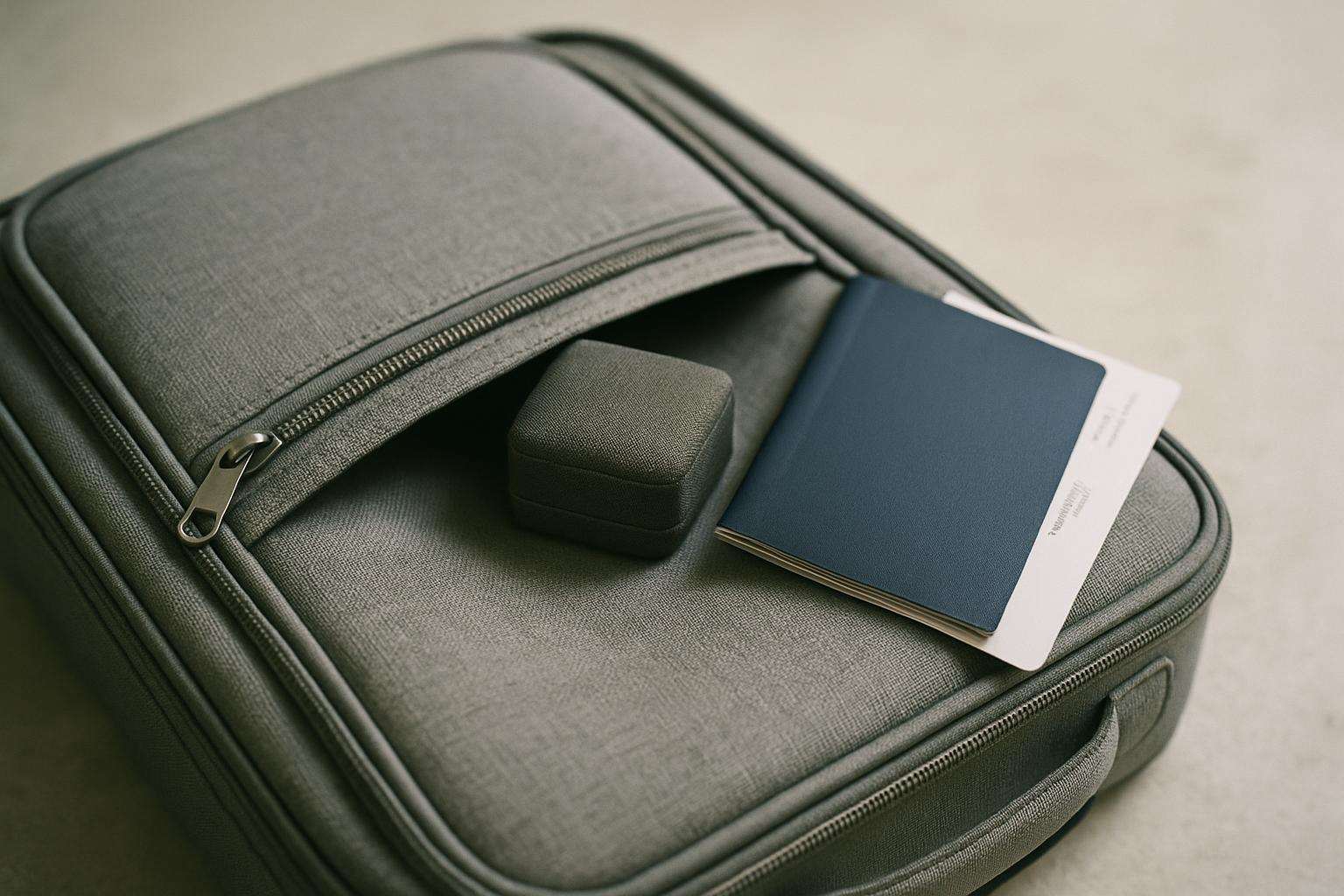
Of everything you will pack for a destination proposal, one item is both the most valuable and the most emotionally loaded: the ring. Getting it to your destination safely — and, if it is a surprise, secretly — is a small logistics problem with a very high cost of failure. The good news is that the rules are clear and the tactics are simple. Here is the complete pre-flight playbook: what TSA actually requires, when ring insurance matters, how customs works on re-entry, and how to keep the ring hidden from the person you are about to surprise.
The TSA reality: carry it on, keep it close
Start with the single most important rule: the ring goes in your carry-on, never in checked luggage. TSA's own guidance is to keep valuables like jewelry with you in the cabin, and jewelry is fully allowed through screening in carry-on bags with no requirement to declare it.[TSA] Checked bags pass through many hands out of your sight, are occasionally delayed or lost, and are the one place insurers most often limit coverage for valuables.
You do not need to remove the ring and place it in a bin — a slim box or pouch in your bag is fine — but if you are anxious about the X-ray image or your partner seeing it, you have a specific right worth knowing: you can ask a TSA officer for a private screening away from other passengers.[TSA] Officers handle proposal surprises routinely and are generally glad to be discreet if you quietly explain the situation.
The two-line rule: (1) Ring in the cabin, on your person or in a bag you never lose control of. (2) If you are proposing in secret, request a private screening rather than risk your bag being opened beside your partner.
Insure it before you go
A modern engagement ring is worth protecting, and standard homeowners or renters insurance frequently caps jewelry coverage well below a ring's value — and may exclude international loss entirely. A dedicated jewelry policy solves this. Jewelers Mutual, the best-known specialist, offers worldwide coverage for loss, theft, damage, and even mysterious disappearance, typically for roughly 1–2% of the ring's appraised value per year.[Jewelers Mutual]
Before you travel, do three things:
- Get a current written appraisal from the jeweler stating the ring's value.
- Photograph the ring from several angles and keep the images and receipt in the cloud.
- Confirm your policy covers international travel and the specific perils you are worried about — loss, theft, and damage abroad.
Given the average US ring now costs several thousand dollars, a policy costing a few dollars a month is cheap insurance for an item you literally cannot replace.
Customs: what to declare on re-entry
For a ring you bought in the US and are simply taking abroad and bringing home, there is generally nothing to declare — it is personal jewelry you already own. The rules only bite if you buy a ring overseas. U.S. Customs and Border Protection sets a personal duty-free exemption for returning residents (commonly $800), and goods purchased abroad above that exemption must be declared on re-entry and may be subject to duty.[CBP]
To avoid any question about a ring you already owned, carry the jeweler's appraisal or original receipt showing the US purchase. Penalties for failing to declare a foreign purchase far exceed any duty, so the honest rule is simple: declaring personal jewelry you already own is duty-free, and when in doubt, declare.
Keeping the surprise intact
If the proposal is a surprise, the packing problem becomes a secrecy problem. The principles are: keep the ring small, close, and out of shared spaces.
| Tactic | Why it works |
|---|---|
| Ditch the bulky retail box for a slim box or sunglasses case | Draws no attention on the X-ray or in a pocket |
| Carry it in a pocket, not a shared bag | Partner won't stumble on it; items on your person rarely prompt a bag search |
| Pack it yourself when your partner isn't around | No accidental discovery during packing |
| Book confirmations on an email your partner doesn't share | A visible photographer or dinner confirmation is the #1 giveaway |
| Wear the box in a front jacket pocket on travel day | Never leaves your body; nothing to forget or lose |
The two most common slip-ups are a visible confirmation email and a partner rummaging in a shared bag — control both and the surprise holds. And if you are anxious at security, remember the private-screening option exists precisely for moments like this.
The pre-departure checklist
Put it together and the whole thing takes ten minutes to get right: appraise and insure the ring, photograph it, move it to a slim discreet case, pack it in your carry-on or on your person, keep confirmations off shared accounts, and know your right to a private screening. Do that and the ring arrives safe, insured, and secret — leaving you free to focus on the only part that matters. For the ring decision itself — styles, sourcing, and what to spend — see our sister site Carat Yes; and once the destination is set, pair this with our guides on hiring a proposal photographer and the most romantic proposal spots by vibe.
Frequently asked
Can I bring an engagement ring through TSA security?
Yes. Jewelry, including an engagement ring, is allowed through TSA screening in both carry-on and checked bags, and there is no requirement to declare it to the officer. TSA's own guidance is that you should keep valuables like jewelry in your carry-on rather than checked luggage. For the ring, the simplest approach is to leave it in a slim box or pouch in your carry-on; you do not need to remove it and place it in a bin, though you can if you prefer. If you are worried about the ring being seen on the X-ray or by your partner during screening, you can ask the officer for a private screening away from other passengers — TSA explicitly allows this.
Should I keep the ring in a carry-on or checked bag?
Always carry-on, never checked. Checked luggage is handled by many people out of your sight, is occasionally lost or delayed, and most travel and homeowners policies limit or exclude coverage for valuables lost from checked bags. Jewelers Mutual and TSA both advise keeping fine jewelry with you in the cabin. Keep the ring on your person or in a bag that never leaves your control — an interior zip pocket of a personal item works well. If you are proposing and want to hide it, a slim box in a jacket pocket or the small pocket of a backpack is discreet and keeps the ring within reach for the entire journey. The one thing you should never do is check the ring in a bag you will not see again until the carousel.
Do I need special insurance to travel with an engagement ring?
It is strongly recommended, especially for an expensive ring. Standard homeowners or renters insurance often caps jewelry coverage well below a modern engagement ring's value and may not cover loss or theft while traveling internationally. A dedicated jewelry policy — Jewelers Mutual is the best-known specialist — provides worldwide coverage for loss, theft, damage, and even mysterious disappearance, typically for roughly 1–2% of the ring's appraised value per year. Before you travel, get a current written appraisal, photograph the ring, and confirm your policy covers international travel and the specific perils you are worried about. Given that the average US engagement ring now costs several thousand dollars, a policy costing a few dollars a month is inexpensive protection for an irreplaceable item.
Do I have to declare an engagement ring at customs?
For a ring you bought in the US and are simply taking abroad and bringing home, there is generally nothing to declare, because it is personal jewelry you already own. The rules bite when you buy a ring abroad: US Customs and Border Protection sets a personal duty-free exemption (commonly $800 for returning residents), and jewelry purchased overseas above your exemption must be declared on re-entry and may be subject to duty. To avoid any question about a ring you already owned, carry the jeweler's appraisal or original receipt showing you bought it in the US before the trip. When in doubt, declare — CBP penalties for failing to declare far exceed any duty owed, and declaring personal jewelry you already own is duty-free.
How do I keep the ring hidden from my partner while traveling?
The key is keeping the ring small, close, and out of shared spaces. Take it out of the bulky retail box and use a slim ring box, a padded pouch, or even a clean sunglasses case that draws no attention. Keep it in a pocket or bag your partner never goes into, and pack it yourself when they are not around. At security, if you are nervous, request a private screening. Book any confirmations — the photographer, the special dinner — using an email or account your partner does not share. Some proposers wear the ring box in a front jacket pocket the entire travel day so it never leaves their body. The most common slip-ups are a visible confirmation email and a partner rummaging in a shared bag, so control both.
What if TSA opens my bag and finds the ring in front of my partner?
This is the scenario proposers fear most, and it is largely avoidable. First, put the ring in your carry-on in a plain slim case so it does not stand out on the X-ray as an obvious jewelry box. If you are especially worried, discreetly ask a TSA officer for a private screening before your bag goes through — you can step aside from your partner. TSA officers handle proposal surprises routinely and are generally happy to be discreet if you quietly explain. As a backup, keep the ring in a pocket rather than a bag, since items on your person are less likely to prompt a bag search. Preparation, not luck, is what keeps the surprise intact.