Travel Smart
Carry-On-Only Honeymoon Packing Strategy: 10 Days in One Bag
No checked-bag fees, no carousel, no risk of lost formalwear. A repeatable framework for packing a 10-day beach-and-city honeymoon into a single carry-on.
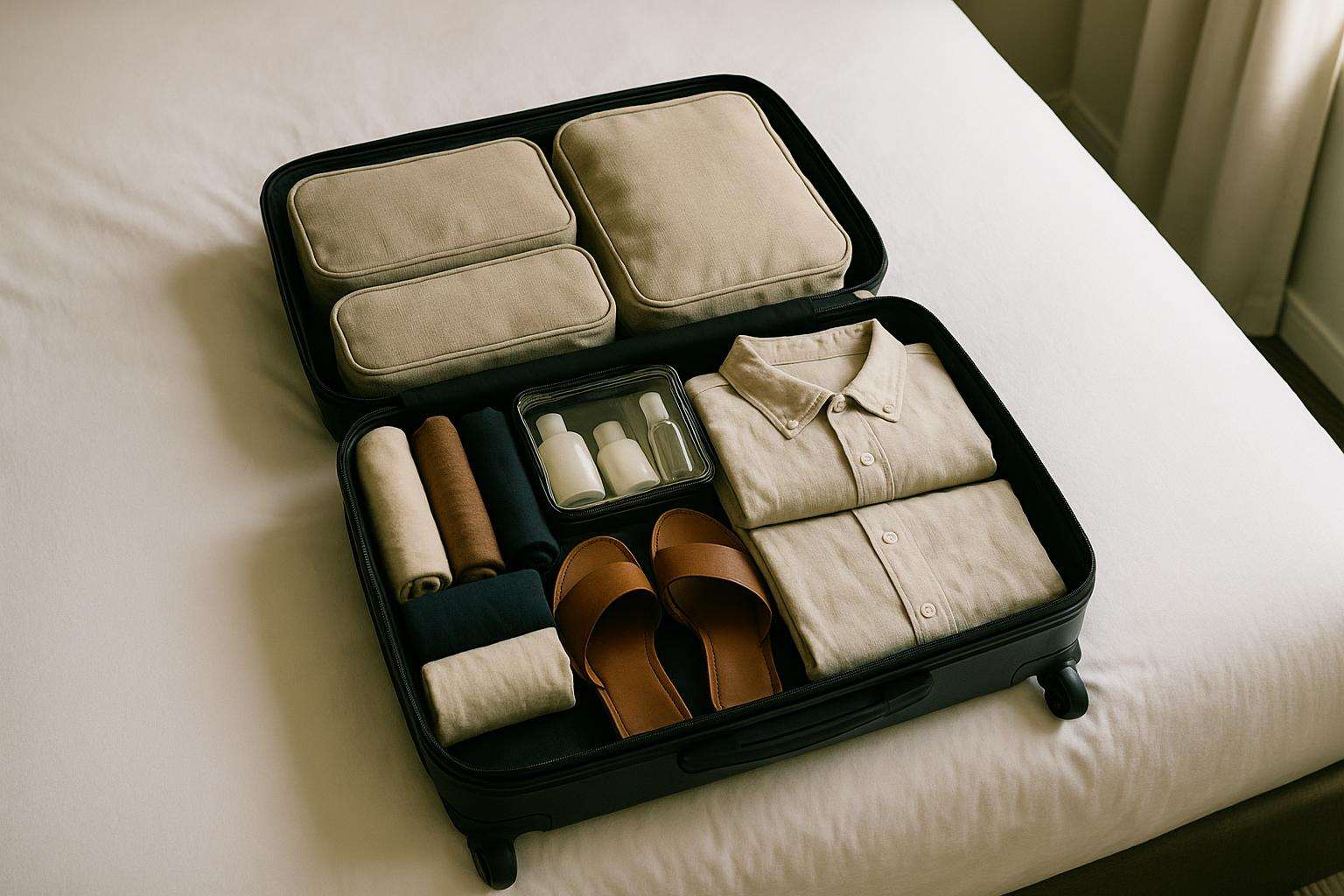
Carry-on-only travel for a 10-day honeymoon is achievable, and the discipline is worth it. You skip checked-bag fees (typically $35 to $70 each way on U.S. carriers, more internationally), you skip the carousel, and you carry zero risk of losing your luggage on a trip where lost formalwear or swimwear is genuinely consequential, not a mere inconvenience. The system below is repeatable: learn it once and every future trip gets easier.
The TSA 3-1-1 reality in 2026
Start with the constraint that shapes everything else. Per the TSA's liquids, aerosols, and gels rule, liquids, gels, aerosols, creams, and pastes must be in containers of 3.4 oz (100 mL) or less, packed in a single clear quart-sized zip-top bag, one bag per passenger. Prescription medications in liquid form are exempt, declare them at the checkpoint and keep them in their original labeled containers.
There are no announced changes to the 3-1-1 rule for standard security lanes in 2026. TSA PreCheck does not lift the liquid restriction, but it does let the quart bag stay inside your carry-on during screening, which reduces friction at the checkpoint.
Beat the liquid limit with solids
The single most effective carry-on move is shifting toiletries to solid formats. Solid shampoo bars (Ethique, HiBar), conditioner bars, solid deodorant, and bar soap eliminate the quart-bag volume constraint almost entirely, a fully solid toiletry kit fits in a small packing cube with no separate quart bag required. For the liquids that remain (sunscreen, serum, cologne or perfume), the 3.4 oz limit applies; a 3 oz travel sunscreen tube is carry-on compliant by design.
The 5-4-3-2-1 clothing framework
A reliable baseline for 10 days:
- 5 pairs of underwear and socks
- 4 tops (two casual, one activewear, one dressier)
- 3 bottoms (one versatile pair of pants, one shorts or swimwear, one skirt or second pair of pants)
- 2 pairs of shoes (one versatile walking shoe or sandal, one dressier option)
- 1 jacket or light layer
The count works over 10 days because of fabric choice. Merino wool tops (Smartwool Everyday Tee, Unbound Merino) earn re-wears without odor, materially reducing how many you need to pack. Two operational rules multiply the benefit: wear your bulkiest items, shoes and a jacket, on travel days rather than packing them, and choose a color palette where every top pairs with every bottom.
Packing cubes: Peak Design vs. Eagle Creek
Both brands sit at the top of the 2026 packing-cube market, and they optimize for different things.
The Peak Design Packing Cube (Medium ~$39.95; Small ~$23.96) uses a self-healing 70D nylon-polyester blend, Pack Hacker notes the fabric visibly closed after an accidental puncture in testing, with a clamshell peel-back lid that opens one-handed and a clean-dirty divider that separates worn from fresh clothing inside a single cube. It offers the fastest clothing access of any cube tested.
The Eagle Creek Pack-It Isolate Compression Set (S + M, ~$48.99) adds a dedicated secondary compression zipper that physically compresses the contents after packing, demonstrably reducing volume versus stretch-fabric alternatives when fully loaded. Per a head-to-head comparison, Eagle Creek backs the set with a lifetime warranty and uses a more abrasion-resistant polyester ripstop shell.
| Feature | Peak Design | Eagle Creek Isolate |
|---|---|---|
| Access | One-handed peel-back lid (fastest) | Standard zip |
| Compression | Fabric stretch | Dedicated compression zipper |
| Clean/dirty divider | Yes, in-cube | No |
| Warranty | Standard | Lifetime |
| Shell | Self-healing 70D blend | Abrasion-resistant ripstop |
A practical system: a Medium cube for tops and layers, a Small for underwear and socks, a quick-access toiletry cube (or the quart bag) near the top for checkpoint removal, and a dedicated shoe bag (Peak Design Shoe Pouch, ~$25–$30) at the base to keep footwear off clean clothing. Cubes do more than compress, they turn unpacking into a five-second operation: on a multi-stop honeymoon you lift out only the cube you need and leave the rest packed, which keeps a shared hotel room orderly and means you are never living out of an exploded suitcase.
Loading the bag: sequence matters
How you load a hard-shell carry-on affects both capacity and access. Put the heaviest items, shoes in their pouch and any denim, at the wheel end so weight sits low when the bag stands upright. Lay the tops-and-layers cube flat across the main compartment, the underwear-and-socks cube beside it, and slide flat items (a swimsuit, a packable rain shell) into the lid pocket. Keep the toiletry pouch and quart bag at the very top or in an outer pocket so you can pull them for screening without unpacking. Reserve two to three inches of buffer rather than packing to the brim, an overstuffed carry-on bulges past the sizer even when its folded dimensions are legal, and gate agents measure the bulge, not the spec sheet.
The bag itself
Per Away's carry-on comparison, the standard Carry-On (21.7" x 14.4" x 9", 41L, ~$275 as of 2026) is the most reliably airline-compliant choice for international itineraries and fits every major U.S. carrier's overhead limits. The Bigger Carry-On adds about 8L but exceeds published limits on several European and Canadian carriers, making it a domestic-first bag. A 40 to 45L hard-shell carry-on accommodates the 10-day wardrobe above with two to three inches of buffer; always verify dimensions against your specific airline before booking, since budget carriers enforce tighter physical sizers.
Heading somewhere rugged rather than a beach-and-city split? Our adventure and safari packing list covers the weight-limited, bush-flight version of this same discipline.
Frequently asked
Is it really possible to pack 10 days into one carry-on for a honeymoon?
Yes, and the discipline pays off directly. Carry-on-only travel eliminates checked-bag fees, typically $35 to $70 each way on U.S. carriers and more on international routes, ends carousel waiting, and removes the risk of lost luggage on a trip where lost formalwear or swimwear is genuinely consequential. The two enabling moves are shifting toiletries to solid formats to sidestep the liquid limit, and using a re-wear-friendly clothing framework such as 5-4-3-2-1 built around Merino wool tops. A 40 to 45 liter hard-shell carry-on accommodates a 10-day beach-and-city wardrobe using this system with roughly two to three inches of buffer, so the constraint is real but comfortably workable.
What is the TSA 3-1-1 liquid rule in 2026?
The rule remains unchanged in 2026: liquids, gels, aerosols, creams, and pastes must be in containers of 3.4 ounces (100 mL) or less, all packed in a single clear quart-sized zip-top bag, one bag per passenger. Prescription medications in liquid form are exempt; declare them at the checkpoint and keep them in their original labeled containers. There are no announced changes to the 3-1-1 rule for standard security lanes in 2026. TSA PreCheck does not lift the liquid restriction, but it does allow the quart bag to remain inside your carry-on during screening, which reduces checkpoint friction. Confirm current rules on the TSA website before you fly, since policies can change.
How do I handle toiletries without a big quart bag?
Shift toiletries to solid formats wherever possible. Solid shampoo bars, conditioner bars, solid deodorant, and bar soap eliminate the quart-bag volume constraint almost entirely; a fully solid toiletry kit fits in a small packing cube with no separate quart bag required. Brands like Ethique and HiBar make travel-friendly bars. For the liquids that remain, sunscreen, serum, cologne or perfume, the 3.4-ounce limit applies, so decant into travel bottles or buy travel sizes. A 3-ounce travel sunscreen tube is carry-on compliant by design. This approach frees up the quart bag for the few genuine liquids you cannot replace, and keeps your kit compact enough for a single bag.
What is the 5-4-3-2-1 packing framework?
It is a reliable clothing baseline for a 10-day trip: 5 pairs of underwear and socks, 4 tops (two casual, one activewear, one dressier), 3 bottoms (one pair of versatile pants, one shorts or swimwear, one skirt or second pair of pants), 2 pairs of shoes (one versatile walking shoe or sandal, one dressier option), and 1 jacket or light layer. The trick that makes 10 days work on this count is fabric choice: Merino wool tops earn multiple re-wears without odor, materially reducing how many you need. Wear your bulkiest items, shoes and jacket, on travel days rather than packing them, which reclaims the most space in the bag.
Peak Design or Eagle Creek packing cubes for a honeymoon?
Both are top-ranked in the 2026 market and serve slightly different priorities. The Peak Design Packing Cube uses a self-healing 70D nylon-polyester blend with a clamshell peel-back lid that opens one-handed and a clean-dirty divider that separates worn from fresh clothing within a single cube, giving the fastest clothing access of any cube tested by Pack Hacker. The Eagle Creek Pack-It Isolate Compression Set adds a dedicated secondary compression zipper that physically reduces volume after packing, and is backed by a lifetime warranty with a more abrasion-resistant polyester ripstop shell. Choose Peak Design for access speed and clean-dirty separation; choose Eagle Creek for maximum compression and warranty. A practical system uses a Medium for tops and a Small for underwear and socks.
Which carry-on size is safest for international honeymoon travel?
The Away standard Carry-On (21.7 by 14.4 by 9 inches, 41 liters, roughly $275 as of 2026) is the most reliably airline-compliant choice for international itineraries; it fits within the stated overhead limits of all major U.S. carriers. The Bigger Carry-On adds about 8 liters but exceeds published limits on several European and Canadian carriers, making it a domestic-first bag. For Europe and Southeast Asia in particular, a 40 to 45 liter hard-shell carry-on that clears published limits is the safe target. Always verify the specific dimensions against your airline's current policy before booking, because budget carriers such as Ryanair and Wizz Air enforce smaller physical sizers than the major legacy airlines.