Travel Smart
Honeymoon Photography Gear Guide: Cameras, Underwater Housings & Drones
A practical 2026 kit for couples who want documentary-quality images without a crew: the right mirrorless body, an underwater housing that fits it, and a drone you can legally fly.
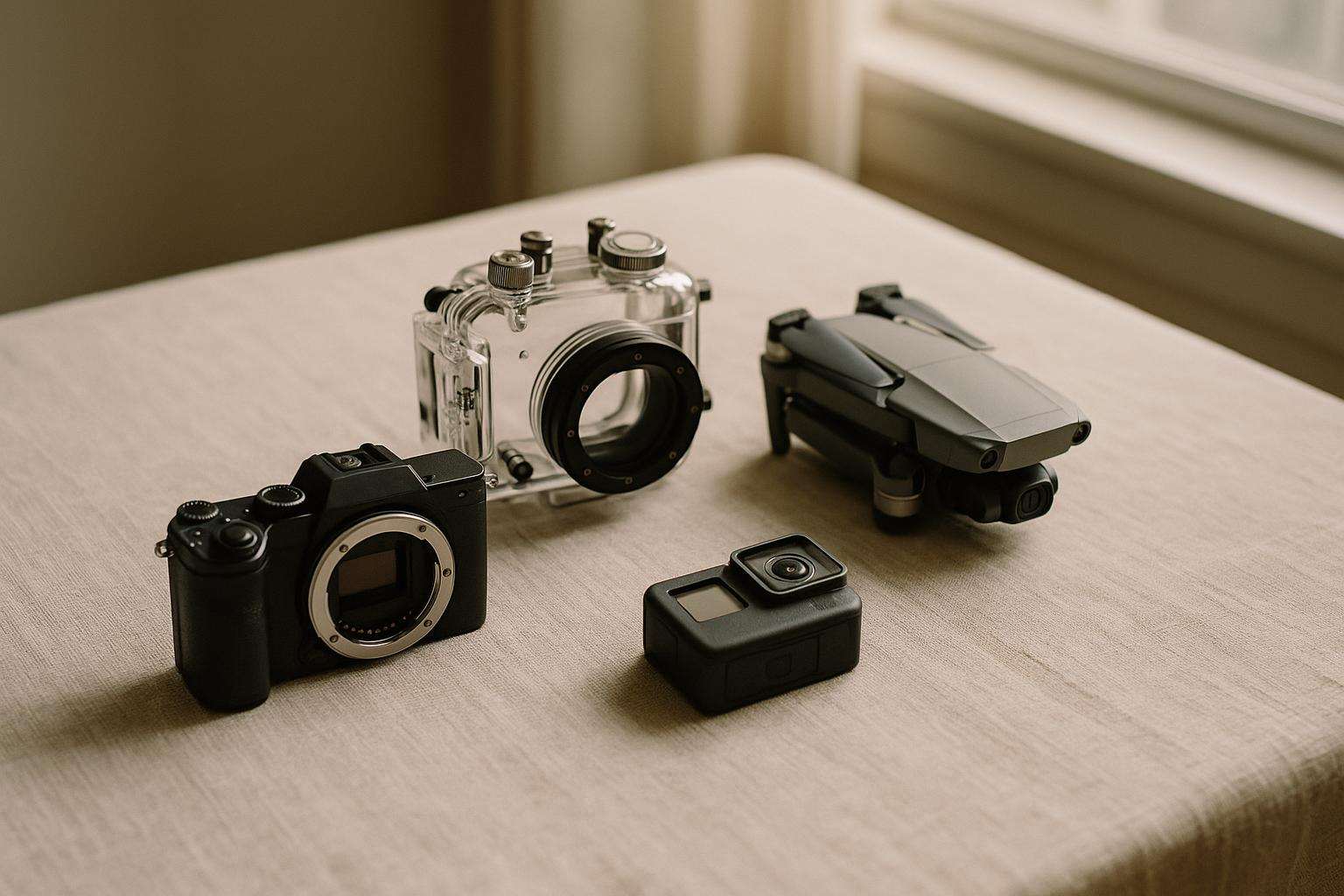
For honeymoon couples who want documentary-quality images without hiring a crew, the 2026 gear market is mature and cleanly segmented. Your entire kit resolves into three categories: a mirrorless camera for the full range of land photography, an action camera or underwater housing for water environments, and a compact drone for aerial context. Get one good choice in each category and you can capture nearly every moment of the trip yourself. The one area that trips couples up is not gear at all, it is the tangle of destination drone laws, which have tightened materially and carry real penalties. This guide covers both.
The land camera: compact mirrorless
For travel couples, the priorities are body size, autofocus reliability for candid and portrait work, and ecosystem cost, in roughly that order. The Sony a6700 (APS-C, approximately $1,100 body-only) remains the dominant compact mirrorless for travel: its 26MP sensor, AI-driven subject-recognition autofocus, and 5-axis in-body image stabilization produce publishable results in a jacket-pocket-sized body. It is the camera you will actually carry every day, which is the whole point.
Couples who want full-frame image quality should consider the Sony a7C II (~$2,200 body) for its 33MP sensor in a remarkably small form factor, or the Canon EOS R8 (~$1,300), the most accessible full-frame mirrorless for anyone already holding Canon lenses. Resist the pull of headline megapixel counts; for honeymoon photography, dependable autofocus and portability matter far more than the difference between 26 and 33 megapixels. A camera left in the hotel safe because it is too bulky captures nothing.
The water kit: housings and action cameras
Water is where smartphones fall short and dedicated gear earns its place. For casual snorkeling and adventure clips, the GoPro Hero 13 Black ($399) is waterproof to 10 meters natively, shoots 5.3K/60fps video and 27MP stills, and delivers HyperSmooth 6.0 stabilization, per the GoPro product page, all with no housing required. It is the lowest-friction way to shoot in and around water.
If you own a mirrorless camera and want genuinely superior underwater stills, add a dedicated polycarbonate housing. Backscatter and other testers point to the Ikelite 200DL (rated to 60 meters, with a swappable lens-port system, roughly $350 to $600 depending on camera model) and the SeaFrog 40M housing (rated to 40 meters with full camera control) as the practical recreational options; Nauticam's aluminum professional housings are superb but cost more than most mirrorless cameras and make little sense for honeymooners. For couples who own no camera at all, the Olympus TG-7 (~$450) is a purpose-built waterproof compact rated to 15 meters that comfortably beats smartphone quality underwater.
The aerials: drones you can actually fly
The DJI Mini 4 Pro (249 grams, 4K/100fps video, a 1/1.3-inch CMOS sensor, f/1.7 aperture, 34-minute flight time, $759 with the RC-N2 controller) is the honeymoon drone, per DJI's specifications. It generates sweeping aerial footage and above-the-couple portraits that no ground-based camera can replicate, and it folds down small enough to travel easily. A drone and a GoPro are complementary rather than competing tools; a reasonable honeymoon kit carries both.
The catch is legality, and it is a serious one.
Drone laws by destination: the ones that surprise couples
Three popular honeymoon destinations illustrate how far the rules have tightened. In the Maldives, per Drones Gator, there is no weight-based exemption: every flight needs approval from the resort or island council, the Maldives National Defence Force, and the Civil Aviation Authority, submitted by email only and requiring two to three weeks to process. The restriction protects Trans Maldivian Airways' seaplanes, which operate at low altitudes between resort islands.
In Bali, a January 2025 DGCA directive removed the sub-250g exemption specifically for Bali, so every drone including the Mini 4 Pro must be pre-registered before arrival, with a 15-kilometer no-fly buffer around Ngurah Rai Airport covering Kuta, Seminyak, Sanur, Nusa Dua, and Jimbaran, and penalties reaching deportation. Italy requires ENAC registration for all camera drones via the D-Flight portal (about 90 euros, one-time) plus mandatory third-party liability insurance of at least 920,000 euros, with no-fly zones over Rome's historic center, Florence's centro storico, the Venetian canals, and all national parks, and criminal penalties up to two years for flying where prohibited. The lesson is consistent: research every destination on your itinerary before you pack the drone, complete registration and insurance in advance, and let your resort coordinate approvals where it can. Do that, and the aerials that make a honeymoon film unforgettable are yours legally and safely.
Frequently asked
What is the best travel camera for a honeymoon in 2026?
For most couples, the Sony a6700 (APS-C, around $1,100 body-only) is the sweet spot. Its 26MP sensor, AI-driven subject-recognition autofocus, and 5-axis in-body stabilization produce publishable images in a body that fits a jacket pocket, and it nails the candid, portrait, and travel work honeymooners actually shoot. Couples wanting full-frame image quality should look at the Sony a7C II (~$2,200), which packs a 33MP sensor into a remarkably compact body, or, if you are already invested in Canon glass, the Canon EOS R8 (~$1,300), the most accessible full-frame Canon mirrorless. Prioritize autofocus reliability and body size over headline megapixels, since a camera you actually carry everywhere beats a heavier one left in the room.
Do I need an underwater housing, or is a GoPro enough?
It depends on how much water time you expect and how good you want those images to be. For casual snorkeling and adventure clips, the GoPro Hero 13 Black ($399) is waterproof to 10 meters natively, shoots 5.3K/60fps video and 27MP stills, and needs no housing, which makes it the low-effort choice. If you own a mirrorless camera and want genuinely superior underwater stills, a dedicated polycarbonate housing rated to 40 meters, such as the Ikelite 200DL or a SeaFrog housing, gives you full camera control at depth. If you own no camera at all, the Olympus TG-7 (~$450) is a purpose-built waterproof compact rated to 15 meters that beats smartphone image quality underwater without any housing.
Is the DJI Mini 4 Pro exempt from drone rules because it's under 250g?
No, and assuming so is one of the most expensive mistakes honeymooners make. The Mini 4 Pro weighs 249 grams specifically to qualify for lighter registration in some countries, but that exemption is far from universal. As of January 2025, Indonesia's DGCA directive removed the sub-250g exemption specifically for Bali, so every drone including the Mini 4 Pro must be pre-registered before arrival. Italy requires registration for any drone with a camera plus mandatory third-party liability insurance. The Maldives has no weight-based exemption at all. Never assume a sub-249g drone is automatically exempt outside the United States, and complete all registration and permitting at least four weeks before departure.
Can I fly a drone in the Maldives on my honeymoon?
Only with advance approval, and it is genuinely difficult. According to Drones Gator, the Maldives has no weight-based exemption, and every flight requires approval from the resort or island council, the Maldives National Defence Force, and the Civil Aviation Authority. Applications are submitted by email only and take two to three weeks to process. The restriction exists because Trans Maldivian Airways operates seaplane traffic at low altitudes (roughly 300 to 1,500 feet) between resort islands, so uncoordinated drones are a real collision hazard. If aerial footage of your overwater villa matters to you, start the permit process well over a month out, and confirm directly with your resort, which often coordinates approvals on guests' behalf.
What are the drone rules in Italy for a European honeymoon?
Italy's ENAC requires registration for all camera drones, administered through the D-Flight portal for a one-time fee of about 90 euros, and mandatory third-party liability insurance of at least 920,000 euros per incident. No-fly zones cover Rome's historic center, Florence's centro storico, all Venetian canals and San Marco, and all 25 national parks. Flying in a prohibited zone is a criminal offense that can carry up to two years imprisonment under Italian navigation law. In short, the most photogenic parts of an Italian honeymoon are precisely where you cannot legally fly, so plan aerials for coastal or rural areas outside restricted zones, and complete registration and insurance before you travel.
What's a sensible complete honeymoon photo kit?
A well-balanced kit uses complementary tools rather than one do-everything device. A compact mirrorless body such as the Sony a6700 covers all your land photography, from candid portraits to landscapes and resort interiors. A GoPro Hero 13 Black or an underwater housing for your mirrorless handles water, snorkeling, and adventure activities. A DJI Mini 4 Pro adds sweeping aerials and above-the-couple shots that no ground camera can replicate, but only in destinations where you can legally fly it. Add spare batteries, plenty of fast memory cards, a small travel tripod for the two of you together, and a padded packing solution. Check drone legality for every destination on your itinerary before you pack the drone at all.